

January 18, 2023
Edge Series for Industry
Industrial edge controllers can bridge operational equipment and information systems, processing data locally while preserving a governed path to analytics.
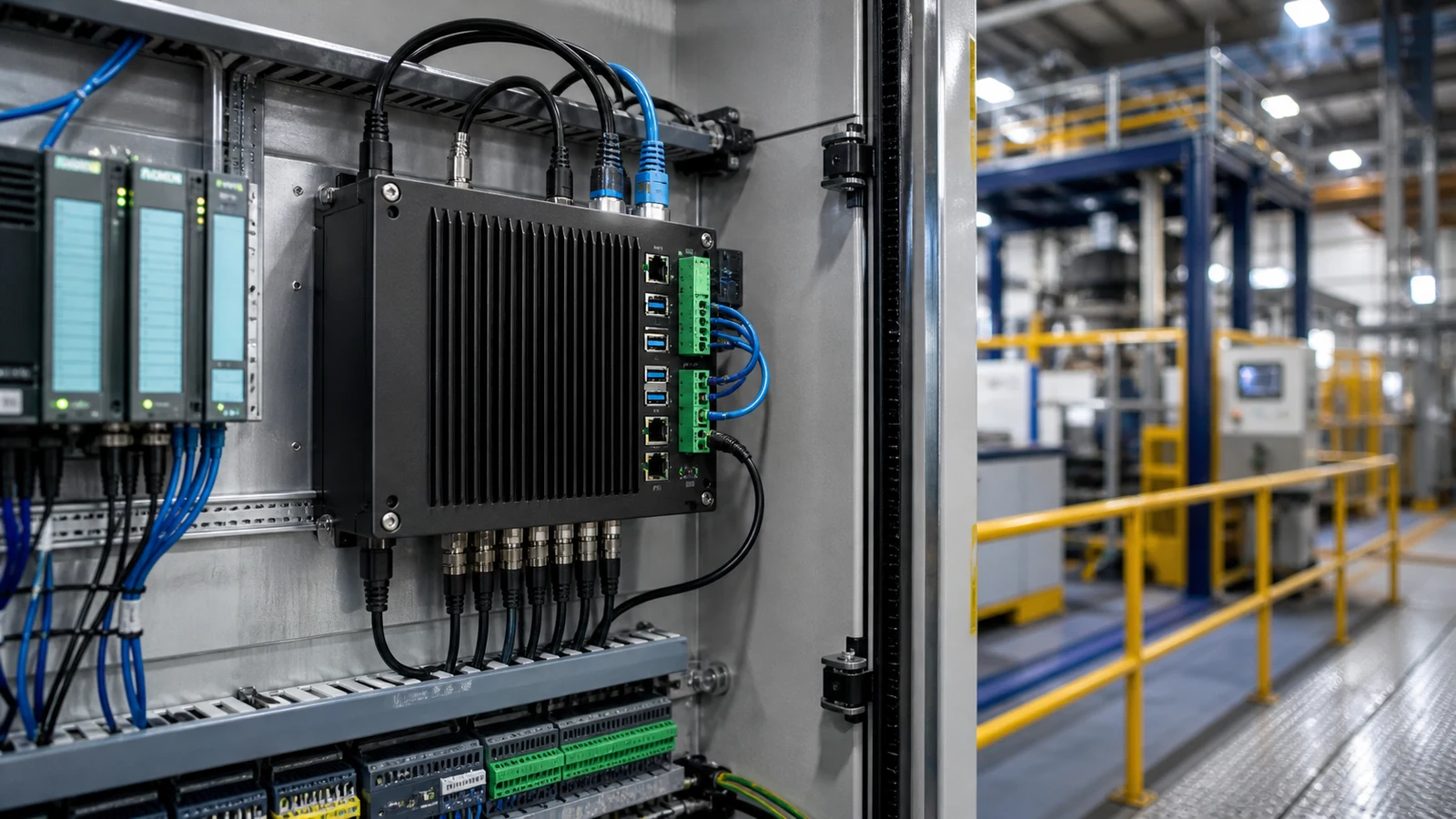
Factories increasingly need more than isolated machine control. Production data must move between sensors, controllers, supervisory systems and business applications, often across multiple sites. Cloud services can add storage and analysis, but industrial operations still require timely local behaviour when a wide-area connection is slow or unavailable. Edge computing provides a middle layer where operational technology and information technology can meet under deliberate control.
Why the edge layer has emerged
Traditional programmable logic controllers remain essential for deterministic machine and process control, yet many digital-transformation projects ask for broader protocol support, larger data histories, remote management and coordination across equipment. Trying to force every function into a small controller or send every raw signal directly to the cloud can create complexity and fragile dependencies.
An industrial edge controller can collect selected field data, perform local calculations and forward governed information to SCADA, on-site applications or cloud services. This does not eliminate PLCs. It creates an integration layer that can preserve local operation while giving analytics and support teams access to useful context.
The architecture should separate safety- or control-critical functions from advisory analytics. Latency, failure behaviour, access control and ownership of each interface need to be documented before remote actions are enabled.
The Seeed Edge Series approach
Seeed Studio's Edge Series is positioned as an operational-technology to information-technology bridge. The family combines industrial inputs and outputs with computing, gateway and protocol capabilities. Depending on the model and software, a device may contribute PLC or PAC functions, an IIoT gateway, an OPC UA server, a lightweight human-machine interface or an industrial computer role.
Field interfaces include combinations of RS-485, RS-232, CAN and digital or analogue I/O, while network options may include Ethernet, Wi-Fi, Bluetooth, cellular and LoRaWAN. Protocol availability is model- and configuration-dependent. A design team should verify the exact hardware revision, isolation, certifications, environmental ratings and software support required for its installation.
The open Raspberry Pi ecosystem used by some models can lower the barrier to development, but openness also increases responsibility. Operating-system maintenance, package provenance, credential management, patching and recovery procedures must be treated as production concerns.
EdgeLogix-RPi-1000 for dense integration
The EdgeLogix-RPi-1000 is based on Raspberry Pi Compute Module 4 and is intended for applications needing substantial on-board connectivity. Published configurations include up to 8 GB of memory and 32 GB eMMC, isolated digital inputs and outputs, RS-485, RS-232, multiple Gigabit Ethernet ports and a local-bus expansion path. Mini-PCIe can support selected cellular or LoRaWAN modules.
Its role can span gateway, industrial computer, OPC UA server and compatible control applications. Software options cited for the platform include Debian or Ubuntu-based environments, CODESYS, Node-RED and MQTT integrations, with cloud connectivity options. Each component should be assessed for licensing, lifecycle, cyber-security and real-time suitability rather than assuming every listed capability belongs in one deployment.
Dense I/O and expansion can suit machine or cell-level projects where several signals and protocols converge. It can also increase the blast radius of poor configuration, which makes versioned deployment artefacts and tested rollback procedures important.
EdgeBox-RPi-200 for compact computing
The EdgeBox-RPi-200 family also uses Raspberry Pi Compute Module 4, with published configurations up to 4 GB RAM and 32 GB eMMC. Its compact interface set includes isolated digital I/O, RS-485, RS-232, USB, HDMI, Gigabit Ethernet and an M.2 slot for supported storage. A Mini-PCIe slot can extend wireless or gateway capability.
This profile can fit a compact protocol gateway, data concentrator, industrial application host or local visualisation node. Technologies commonly associated with the platform include Modbus, OPC UA, MQTT, Node-RED, CODESYS and Ignition. Integration testing should confirm driver support, throughput and behaviour under power or network interruption.
Where a panel display or supervisory application is added, the controller can help connect the production layer with operator and analytics views. Human-machine interfaces still need role-based access, clear alarm design and a safe boundary around control actions.
EdgeBox-ESP-100 for lighter duties
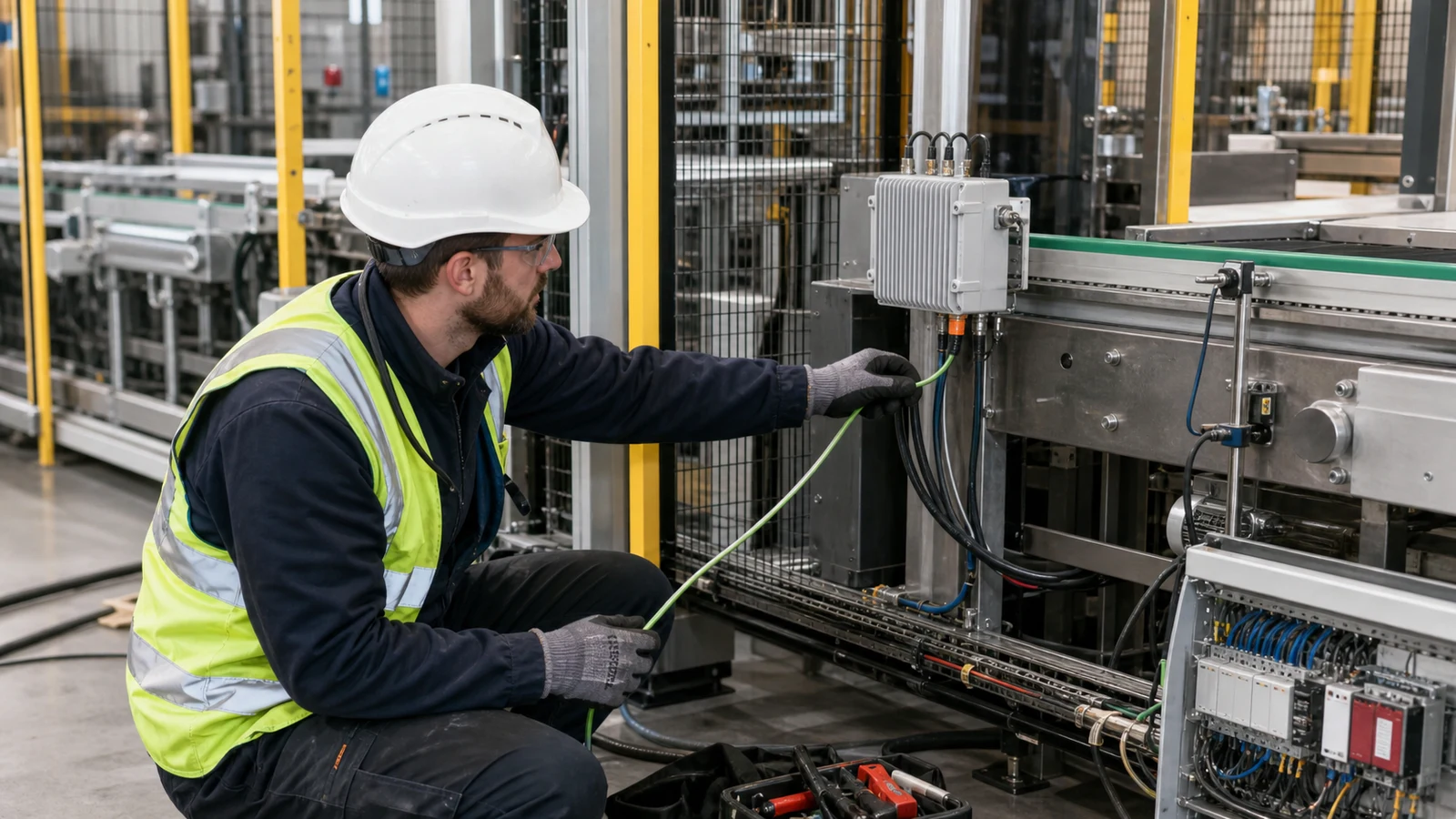
The EdgeBox-ESP-100 is built around ESP32 for lighter monitoring and automation tasks. It combines isolated I/O with CAN, RS-485 and Ethernet, plus on-chip Wi-Fi and Bluetooth and a cellular option in published configurations. Its compact, rugged design is intended to help connect an existing controller or remote signals to a wider network.
This model is more constrained than a Compute Module 4 system, which can be an advantage when the job is clearly bounded. Development through ESP-IDF and the device's supported industrial interfaces can suit remote monitoring or gateway functions. Any control use should be assessed against the available software maturity, including the status of advertised IEC 61131-3 support.
Environmental protection, electrical isolation, surge behaviour and applicable product markings should be verified from current manufacturer documentation for the exact unit being procured.
Connect edge data to Nvirosense™
An edge controller becomes operationally valuable when its data model is understandable beyond the cabinet. Nvirosense™ can receive selected environmental and equipment telemetry, retain timestamps and device identity, and present trends, alarms and site comparisons. Normalising tag names, units and quality states at the interface reduces ambiguity downstream.
Local calculations can filter noise, aggregate high-frequency signals or detect a condition that warrants escalation. The raw or source-resolution record required for engineering and audit purposes should still be preserved according to the risk and retention plan. Analytics should be traceable back to the tags, calculation version and time window that produced them.
Store-and-forward behaviour is especially important where connectivity is intermittent. The design should define buffer capacity, duplicate handling, time synchronisation and how users are told that a stream is delayed.
Engineer for lifecycle, not only purchase price
Affordable hardware can widen access to industrial digitalisation, particularly for smaller sites. Total cost, however, includes enclosure and power design, commissioning, spares, software maintenance, cyber-security, support and the skills needed to operate the system. A familiar ecosystem can reduce learning time, but it does not remove lifecycle work.
Availability and reliability claims should be tested against the project's service horizon. Teams should confirm supply, warranty, current conformity documentation and replacement strategy with the manufacturer or supplier. Keeping compatible spares may shorten recovery, provided configurations and secrets can be restored safely.
A staged pilot is often the best proof. Connect a bounded set of signals, measure data completeness and latency, test failure modes and verify that operators can understand the resulting evidence. Expansion should follow demonstrated value and an architecture that remains supportable.
Industrial edge computing can make legacy and modern equipment part of a coherent evidence flow without making cloud connectivity a prerequisite for every local task. The Seeed Edge Series offers several hardware profiles for that bridge; Nvirosense™ adds the monitoring, analytics and traceability layer. The right solution is the one whose interfaces, failure modes and lifecycle responsibilities are explicit from field signal to decision.